
Digital Marketing for Contractors: The Complete Guide to Generating Leads and Actually Answering Them
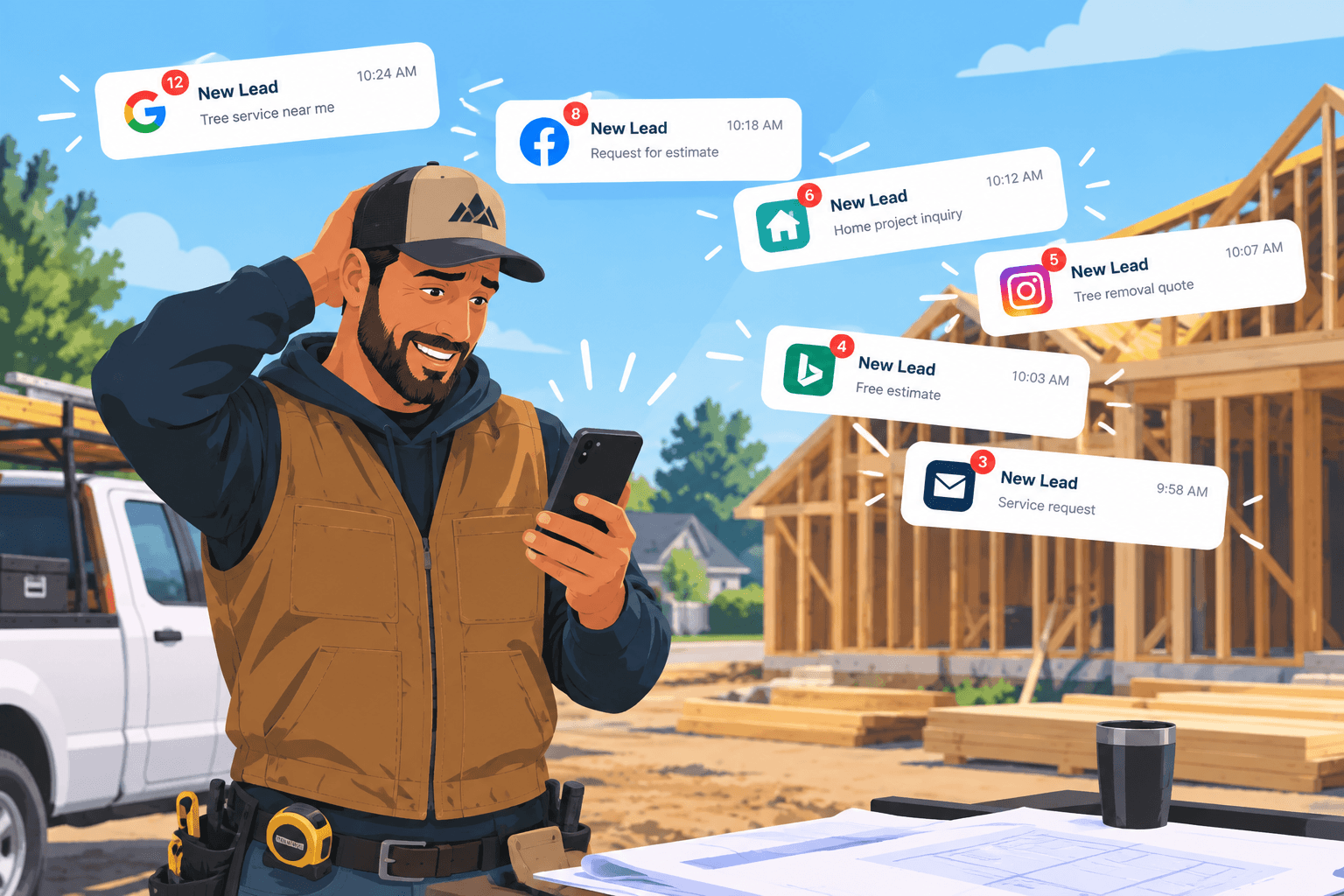
The trouble with most guides to digital marketing for contractors is that they stop halfway. They cover showing up in the map pack, running ads, and waiting for the phone to ring. That work matters, and this guide covers it too. But it's only half of what decides whether your marketing turns into jobs.
The other half starts once a lead comes in. Someone answers it. It reaches the right person instead of an inbox nobody checks. And someone follows up until the homeowner gives a real answer, booked or not. Miss any of those steps and you've paid for a lead that never became work. A plan that stops at lead generation is like a crew that frames a house and never comes back: the structure stands, but nobody can move in.
The demand is real, and it isn't cheap. The phrase 'digital marketing for contractors' gets about 720 searches a month, and the average click costs $12.96, according to DataForSEO. At that price, every lead deserves an answer.
So this guide covers both halves. The generation side first: local SEO, your Google Business Profile, Local Services Ads, and a website built to turn visitors into quote requests. Then the half most guides skip: answering, routing to monitored inboxes, and following up until the homeowner books or says no. It's the picture Grand River Labs works from as a fractional digital department for home services contractors — generation and lead flow run as one system instead of two separate services. By the end, you'll know where to start, what to fix first, and how to stop losing jobs you've already paid for.
What Digital Marketing for Contractors Actually Covers (and What Most Guides Skip)
Digital marketing for contractors covers everything between an online search and booked work: showing up in local search, keeping your Google Business Profile accurate, running Local Services Ads, having a website that turns visitors into quote requests, and handling whatever happens after someone reaches out.
Most guides cover the first four. They explain how to rank and how to run ads, then hand you back to your voicemail. A lead only becomes revenue if somebody answers it, routes it to whoever can act on it, and follows through to a decision. Skip that part and you're paying for demand you never collect.
Local SEO and Google Business Profile: Where Contractor Leads Start
For most contractors, the job starts with a local search. A water heater dies on a Tuesday night, the homeowner types the service plus their town into Google, and the first thing they see is the map pack — the boxed set of listings with ratings, hours, and phone numbers that sits above everything else. That box decides who gets the call.
Earning a spot in it isn't mysterious, but it isn't automatic either. Local SEO comes down to two things working together. The first is consistent business information everywhere your company appears: your name, address, and phone number matching across your website, your profile, and the directories that list you. The second is pages on your site that match what people in your service area actually search for. A page built around the service you offer in the towns you serve does more work than a generic services list ever will.
It helps to know what that visibility costs when you buy it instead. Per DataForSEO, advertisers pay an average of $12.96 a click even for the phrase 'digital marketing for contractors.' Local SEO is how you earn attention in your market rather than renting it by the click.
Your Google Business Profile is often the first thing a potential customer sees, sometimes before your website. Keep it current: the right categories, an accurate service area, real hours, and photos that look like your actual work. Wrong hours or a stale service area send the same signal as an unanswered phone. The business looks open, just maybe not for the person searching. Check that the number on your profile matches the one on your contact page too. A mismatch costs you trust with the customer and consistency in Google's eyes at the same time.
Google gives you more room than most contractors use. List your real services, not just a category. Post the occasional update. Add photos from finished jobs. None of it costs money, only attention, and all of it points at the same goal: looking like the obvious local choice at the moment someone searches. Reviews pull in the same direction and often break the tie between two contractors offering the same services.
One more thing before we move on, because most guides skip it. A well-kept profile puts a ringing phone in your hand. Whether that call becomes a job depends on what happens next: someone answering it, the lead landing in an inbox a person actually monitors, and a follow-up when the first call goes to voicemail. That's the half of lead flow most contractors lose, and it isn't a rankings problem — no amount of SEO fixes an unanswered phone. It's the reason generation and answering belong to one system rather than two projects, and that idea runs through the rest of this guide.
The playbook doesn't change much across trades, either. The mechanics transfer even when the jobs don't, which is why tree service, roofing, and plumbing each get their own guide in this series as they go live. Up next: Local Services Ads, which sit right alongside the map results when someone nearby searches.
Local Services Ads: Pay for Leads, Not Clicks
Local Services Ads flip the usual ad model. You don't pay every time someone clicks. You pay when a lead actually contacts you through the ad. For contractors that matters, because a click never installed anything. You're not buying traffic — you're buying a homeowner who picked up the phone or sent a message. Tying spend to people who've raised a hand makes the budget much easier to justify.
These ads run at the very top of Google search results, above the regular paid listings, so they're the first thing a homeowner sees when the basement floods or the AC dies in July. Leads come in as calls and messages, and you're billed for contacts, not curiosity. Google vets your business before you can run them, and the verification badge does some quiet trust work before you ever say hello.
The trade-off is that every lead carries real cost, so response discipline stops being optional. A lead that rings once and goes unreturned isn't just a missed job. It's money you spent and got nothing back from. And LSA leads don't arrive on your schedule. They show up mid-morning while the crew is on a roof, or in the evening while you're pricing tomorrow's work. If nobody's watching the phone or the inbox in those moments, the lead you paid for evaporates.
This is the half of lead flow most contractors lose — answering, routing, follow-up — and it's the expensive half once LSAs are running. The ad can work perfectly and the lead still dies after the money has changed hands: nobody picked up, the message landed in an inbox no one checks, or the first callback never happened. The generation side did its job. The back half dropped it.
It's the reason Grand River Labs runs lead generation and lead-flow accuracy as one system instead of two separate line items. LSA leads get answered, routed into a monitored inbox, and followed up when the first attempt misses, so the money committed on the generation side doesn't leak out the back. Tracking what comes in pays off too. Spam and wrong-number leads can be disputed with Google instead of eaten as cost, but only if someone is actually logging them.
Before you switch LSAs on, be able to answer three questions: who picks up when a call comes in, where the message lands, and who follows up when the first try misses. If any answer is 'nobody' or 'I'll get to it,' fix the flow first. Paid leads are only as good as the pipeline behind them.
Conversion-Focused Websites: Turning Visitors into Quote Requests
A website only pays off if it gives visitors something obvious to do next. A conversion-focused site is built around one job: turning a visit into a quote request. Plenty of contractor sites look good and still don't do that job. They read like brochures — a services list, a photo gallery, a contact link tucked into the corner — so visitors browse, shrug, and leave. The next step should be impossible to miss: services that are clear within seconds, a phone number that's easy to find from any page, and a contact form short enough that people actually finish it.
Give the form a hard look, because it's where the whole thing succeeds or fails. Every extra field is one more reason for a busy homeowner to quit halfway through. Ask for what you genuinely need to follow up — usually a name, a phone number, and a line about the job — and leave the rest for the conversation. A form like that takes seconds to complete, which is about as much patience as most visitors bring.
Build the site around what customers search for rather than how your business is organized inside. If someone needs roof repair after a storm and your site files that work under a vague label like 'Exterior Services,' you've asked them to translate their problem into your language. They shouldn't have to. The pages that convert are the ones that name the job the way the customer would name it.
Keep in mind that most visitors arrive on a phone, often in the middle of something else — water where it shouldn't be, a branch leaning against the house. Nobody in that situation is settling in for a long browse. The path from landing page to contact needs to be short, with a tap-to-call button in easy reach and a form that doesn't demand much typing. Everything else on the site is secondary to that path.
There's one more piece, and it's the part most guides skip: the website is only half the machine. A submitted form isn't a customer yet. If that request lands in an inbox nobody watches, or sits there while the homeowner calls the next contractor on the list, you've lost the lead your site just earned. A quote request needs to be answered, routed to a monitored inbox, and followed up until there's a real answer either way. That's why the website and the lead flow behind it belong to one end-to-end system rather than a standalone project. The measure that matters isn't how the design looks in a portfolio. It's how many visits turn into conversations.
The Half of Lead Flow Most Contractors Lose: Answering, Routing, and Follow-Up
Leads don't arrive when it's convenient. The call comes while you're on a ladder. The form lands mid-job. The email shows up after hours. And most people won't wait long — a caller who hits voicemail usually dials the next contractor on the list.
Answering means every channel gets picked up, even when your hands are full. Routing means each lead reaches whoever can actually respond, not a generic inbox nobody checks. Follow-up means staying with a lead until you get a yes or a no. The person who's ready next month only becomes a job if somebody stayed in touch.
This is the half of lead flow most contractors never systematize, and it's where paid demand quietly disappears. Getting found is a problem you solve once. Answering and following up is a daily discipline, and it needs a system behind it.
Run It as One System: Lead Generation and Lead Flow Together
The two halves fail separately when different people own them. One vendor fills the top of the funnel, the calls land wherever they land, and nobody owns the gap in between. Running both as one system closes it: the same team that generates the leads also makes sure they're answered, routed to monitored inboxes, and followed up.
That's how Grand River Labs works with home services contractors — as a fractional digital department rather than a vendor you hand a single task to. Local SEO, your Google Business Profile, Local Services Ads, a conversion-focused website, and the lead flow behind them, run end to end. You get the leads, and you actually get to answer them.